


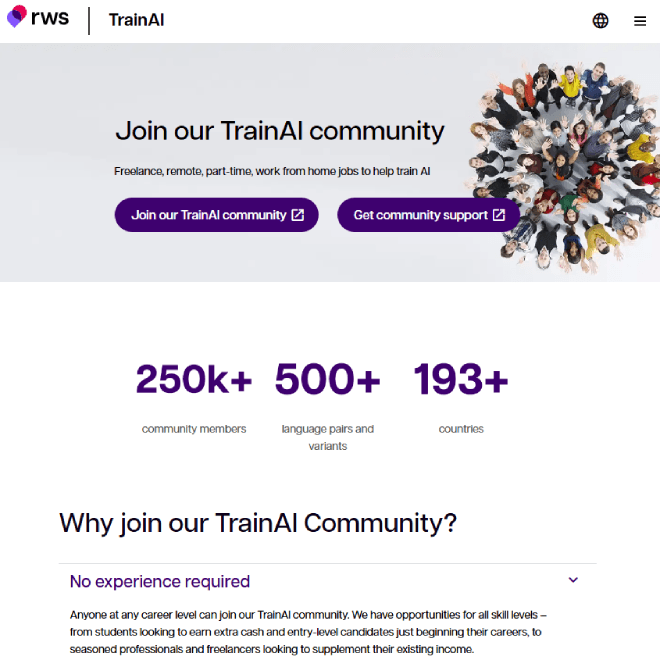
AI Training is a growing and ever expanding category that is quickly becoming a high in demand gig. Think about it, every AI chatbot you interact with needs feedback about how it is doing. This is where you come in. RWS TrainAI is a platform that pays everyday people like you to do that work. Based on our research, the reported pay is competitive for the industry, though some contributors highlight specific drawbacks with this gig such as a confusing payment setup and hard to reach customer service. Read our following review and go in with your eyes open.
Weighing your options? See how RWS TrainAI compares to the rest in AI training jobs compared. New here? My guide on what to expect in your first month breaks it down.
Quick Facts
| Platform Name | RWS TrainAI |
| Earning Potential | $15 to $25/hr |
| Typical Duration | Project-based and varies widely |
| Payment Frequency | 14 or 30 days |
| Required Equipment | Computer |
What’s Inside
- Is RWS TrainAI real and safe?
- How hard is it to sign up?
- Can I do this whenever I want?
- How much money can you really make?
- When and how do you get paid?
- What stuff do you need to start?
- Is the work easy or hard?
- The Pros and Cons of RWS TrainAI
- Final Verdict: Is RWS TrainAI worth your time?
- Frequently Asked Questions
Is RWS TrainAI real and safe?
RWS TrainAI is owned and operated by RWS Holdings, a publicly traded company listed on the London Stock Exchange. It is recognized as one of the largest language and AI data services firms in the world with over 100,000 contributors in their system. The work is legitimate, the tasks are real but navigating the onboarding correctly is critical to ensure you get paid.
The frustration contributors report is not fraud, it is driven by the confusion their payment classification system. RWS assigns you as either a Private Individual or a Freelancer when you sign up. This is important because the payment timeline differs between the two quite drastically. Private Individuals get paid 14 days after a work order is issued whereas Freelancers wait 30 days and must submit their own invoices. Many members do not realize which classification they have until they are waiting on money, so it is important you determine your correct status as soon as you register and hit the payment setup page.
How hard is it to sign up?
Joining RWS TrainAI is very straight forward but not an instant access opportunity. You start by selecting your status (a private individual, sole proprietor, or company) followed by completing a sign-up form including background information about your skills and language abilities. You then have to wait for the recruiting team to review your application and contact you. There is no instant approval with this gig. The wait can vary from days to several weeks.
If accepted, new members are also asked to complete training rounds specific to each project before earning anything. That training is unpaid but prepares you for the actual tasks.
💡 Insider Tip:
A clear profile showing medical, legal, technical, or language expertise gets you into more specialized, better-compensated work from the start.
Can I do this whenever I want?
There is no set schedule and no minimum hours but once opportunities show up, you need to join them in a timely manner. When a project matches your profile, you get notified via email and respond whether you to participate. For each project you accept there is a window with a deadline but you are free to work at your own pace so long as you meet the timeline.
How much money can you really make?
Payout is project based but a good sense of earning potential is around $15 to $25 per hour for general AI annotation and answer rating. If you take on more specialized projects like data analysis or machine learning your opportunity to earn goes up substancially.
RWS claims to conduct annual payout reviews to keep rates fair relative to local cost of living. This is quite rare and shows a genuine commitment to their community. Your earning potential is directly related to how many projects you land and how consistently you complete tasks at a high quality level. Most contributors treat this as a supplemental income as opposed to a standalone paycheck.
When and how do you get paid?
Ok, this is where the biggest point of contention and confusion comes into play. Remember how we mentioned you will be asked to select a correct classification when you register? Your payment timeline depends on this. Private Individuals (which 95% of the people reading this post likely are) are paid 14 days after a work order is issued. The payment is managed via a service called Tipalti and sent by email. If you are classified as a Freelancer you are paid 30 days after the work order, but you must generate their own invoices and banking details.
In both classifications, payment goes via PayPal or direct bank transfer depending on your setup. If you are unsure which classification to select, you can verify it with the RWS team during onboarding to ensure you are clear on payment expectations and timing.
What stuff do you need to start?
Everything is web browser based so you will need a computer and internet connection. You do not need to have prior testing or annotation experience to apply and RWS will provide general training before any work begins. All said, if you are someone with strong written language skills this will help a lot as many tasks involve evaluating text, audio, or images for quality and accuracy.
Is the work easy or hard?
The majority of the work is you rating search results, annotating images or evaluating AI responses according to clear guidelines. Our research shows that based on contributor feedback, the work is often described as repetitive but manageable.
One harder part is there can be a learning curve on each new project because each has its own specific rules and you have to pass training rounds before starting.
The Pros and Cons of RWS TrainAI
| The Pros | The Cons |
|---|---|
| RWS Holdings backing: Publicly traded, global company. | Confusing payment system: Two tracks with different timelines. |
| No experience needed: Training provided for every project. | Slow support: Email only, responses take days. |
| Specialist pay bump: Better rates for language or domain experts. | Inconsistent volume: Project flow is unpredictable month to month. |
Final Verdict: Is RWS TrainAI worth your time?
We think this gig is worth trying with the condition that you get your payment classification all sorted out before starting. This is the universal point of frustration we see from users and the most frustrating experience on the platform. Once you are clear on how you get paid, the gig itself is a solid one.
The Bottom Line: This is a gig to earn supplemental income, not a salary. Go into it with that in mind and be patient as the onboarding process is very involved. Do the training rounds and treat every project invitation as a potential opportunity to earn supplemental income.
Frequently Asked Questions
Private Individual contributors receive payment 14 days after a work order is issued and get payment links sent directly to their email via a service called Tipalti. Freelancers are paid 30 days after the work order but must create their own invoices.
No. RWS explicitly states no prior experience is needed to join the community. Each project comes with its own training and testing rounds that prepare you for the specific tasks.
You do not browse an open list of projects. RWS sends project invitations by email when a new engagement matches your profile.
RWS does not always notify applicants who are not selected for specific projects. Your profile stays in their database and you continue to receive invitations for future projects that match.
Yes. Whether you are classified as a private individual or freelancer, RWS does not withhold taxes. You receive full payment and report it yourself. Keep a log of every work order and payment received to make tax season straightforward.