


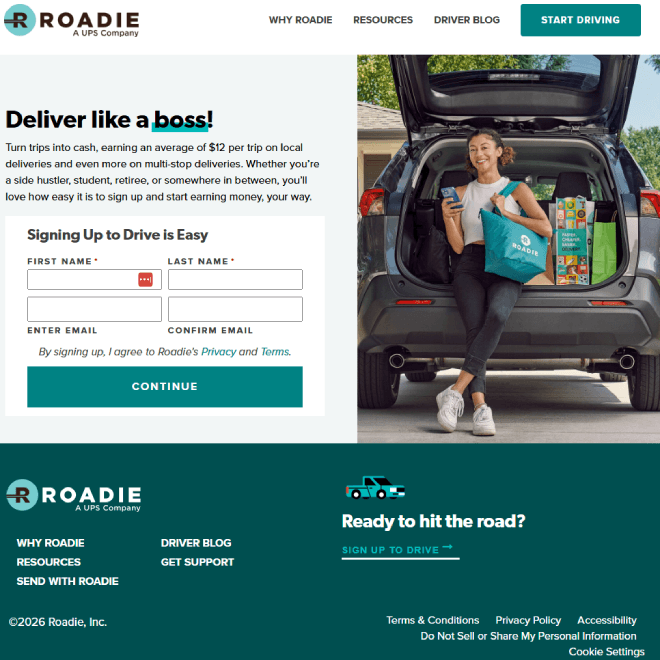
If you are already driving around town, why not earn a couple extra bucks to drop something off on the way? This is the premise behind Roadie, a delivery platform that became so popular it was purchased by and is now owned by UPS since 2021. Roadie connects everyday drivers with businesses and individuals who need packages delivered fast. Whether it’s Home Depot, Best Buy, even Delta Air Lines use this platform for late luggage drop offs. The key with this car required gig is there is no passengers, no food, just packages. Let’s dive into the details with our Roadie review.
Weighing your options? See how Roadie compares to the rest in delivery gigs head to head.
Quick Facts
| Platform Name | Roadie |
| Earning Potential | $8 to $15 per local gig |
| Typical Duration | 30 minutes on average |
| Payment Frequency | Weekly (Tuesdays) or Instant Pay |
| Required Equipment | Vehicle, valid license, auto insurance |
What’s Inside
- Is Roadie real and safe?
- How hard is it to sign up?
- Can I do this whenever I want?
- How much money can you really make?
- When and how do you get paid?
- What stuff do you need to start?
- Is the work easy or hard?
- The Pros and Cons of Roadie
- Final Verdict: Is Roadie worth your time?
- Frequently Asked Questions
Is Roadie real and safe?
Despite being founded in 2014, what gives Roadie all of its credibility is three simple and very recognized letters: UPS. That’s right, UPS (United Parcel Service) acquired Roadie in 2021 and uses it in some cases to power same-day and last-mile delivery for retail clients across the country. The service operates in all 50 states and says they cover more than 20,000 zip codes. It’s a very real gig, not a startup operating out of someone’s garage (sorry Amazon, we know this is how you famously got your start!).
How hard is it to sign up?
The process is incredibly straightforward with the whole sign-up taking about five minutes. There can be a bit of a wait after you initially sign-up before you get going to fully complete your background check. However, there are also reports that of many drivers getting verified the same day.
To begin you you download the Roadie Driver app, provide all your relevant personal details. You’ll be asked to upload your valid driver’s license and proof of insurance. In our view, relying on a standard personal auto policy is risky. We suggest checking with your agent to see if you need a gig-work rider to remain fully covered.
Lastly, you need to take a selfie for identity verification. That’s it, you are done! From here you wait for the background check to clear and if approved you are good to start.
💡 Insider Tip:
After you sign up, its worth it investing in a basic dolly and a set of moving straps. This will open up a whole category of higher-paying gigs that most drivers cannot take. One appliance delivery can pay $50 or more so the math makes sense.
Can I do this whenever I want?
You open the app, browse available gigs in your area, and accept what you want. There is no requirement to have a set schedule and there are no minimum hours. Seven days a week, any time of day. You can also accept multiple gigs at once if everything fits in your vehicle and you can hit the deadlines for each one.
The key is hitting the deadlines and delivery windows that are provided. Don’t say you can make a delivery and put it off. This is a fast way to hurt your credibility on the platform. People are usually excited to receive deliveries, don’t let them down.
How much money can you really make?
We found the real earnings data from almost 7,000 Roadie drivers tracked in 2025 puts the average earner at $12.70 per hour. You’re not moving into the penthouse with that kind of money, but like we said, if you are already a driver it is a great method to earn while you are on the go.
2025 reports show that the top 25% of drivers clear over $16 per hour and the top 10% hit over $20 per hour. However, based on our recent research and current user feedback in 2026, many local deliveries pay between $8 and $15 per hour, depending on the market.
The difference in earnings is exclusively tied to the type of gigs you accept from Roadie. Reports show that the drivers who take on big and bulky deliveries or long-haul runs earn considerably more than those taking short small-item trips.
When and how do you get paid?
Payments are issued weekly by direct deposit every Tuesday. The exception is that once you complete at least five gigs and have been active for more than seven days, instant pay becomes available. There is a cost for this benefit however, as it comes with a $2 fee. However, if you are in a pinch it gets your money into your account the same day you complete a delivery. This is not a widely available option for 99% of other gigs and one of the real benefits offered by Dolly,
What stuff do you need to start?
Any vehicle, a valid license and current auto insurance. This said, be smart. If you are expecting to move a massive dresser in a Honda Civic, that’s not going to work. Only accept gigs that are appropriate for your vehicle. The good news is this part is already somewhat automated. When you join, your vehicle will be categorized into one of five sizes: from small sedan up to cargo van or truck. This allows Dolly to matches gigs to your vehicle accordingly. There is no vehicle inspection but you need a 2010 or newer car to participate.
In addition to your vehicle, a smartphone is required to use the app. Beyond that, as we suggested in our Insider Tip, optional gear like a dolly and moving straps open up higher-paying opportunities.
Is the work easy or hard?
This is attached to your expectations going into each delivery. For the small stuff, the delivery itself is easy. Pick up the item, drive it to the destination, hand it off. You are shown by Roadie exactly what you are delivering ahead of time and what it pays before you accept so there are no surprises.
Now, if you are delivering bulky or heavy items, its obviously a lot more challenging and you absolutely need to be prepared with the right equipment or else your back will be forever aching. Just be smart about it and think through each delivery gig before approach them.
The Pros and Cons of Roadie
| The Pros | The Cons |
|---|---|
| UPS-backed: Major retailers use it. | Can be low pay: Gas and time translate to small earnings. |
| Clear earnings: Know exactly what a gig pays. | Gig competition: No guarantee you get gigs. |
| Easy car standards: 2010 or newer, any model. | Slow support: No phone, chat only. |
Final Verdict: Is Roadie worth your time?
Roadie works best as a supplement to other gig work, not a standalone income. If you are putting miles on your car anyway it can make sense to stack this gig on top. The transparent upfront pay is a real plus but if Roadie is your only gig and you live outside a busy metro area, the numbers are probably going to disappoint you.
The Bottom Line: If you are already driving for DoorDash or running errands, stacking Roadie deliveries on top makes good financial sense. Otherwise it is not likely to be a huge financial winner for you.
Frequently Asked Questions
Certifications open up specific types of deliveries. The Trusted Driver certification opens up more gig types as you build your reputation on the platform. Other certifications cover cargo trailers, extra equipment, and TSA-cleared deliveries like airport luggage runs.
RoadieXD is designed for drivers with larger vehicles like cargo vans, sprinters, or box trucks. Instead of individual gigs you pick up consolidated routes from a warehouse and make multiple stops in one run. Pay is higher and scheduling is more predictable than standard gigs.
Roadie does not provide its own vehicle insurance. You need your own auto policy that covers commercial or delivery use. Many personal auto policies do not cover you when you are delivering for pay, so check with your insurer.
Document everything with photos before you touch it. Take clear pictures of the item at pickup before you load it. If it arrives at the destination in worse condition than you found it, your photos are your only protection in a dispute.
Yes. Roadie pays you as an independent contractor and nothing is withheld. You will receive a 1099 at the end of the year. Keep a log of every gig you complete and the mileage you drove for each one. Mileage is tax-deductible as a business expense, which can meaningfully reduce your tax bill.